Pinealon cell research and cognitive claims
The cited Pinealon research is a laboratory cell study, not a human cognition trial of Pinealon 20mg Pen. The 2011 laboratory study examined cerebellar granule cells, neutrophils and PC12 cells under induced oxidative stress. Its endpoints concerned reactive oxygen species and necrotic cell death. Pinealon cell-stress study.
The paper measured accumulation of reactive oxygen species under those induced-stress conditions. It separately used a propidium-iodide test to assess necrotic cell death. Pinealon cell-stress study.
What is Pinealon?
The study identifies pinealon as the synthetic tripeptide Glu-Asp-Arg. The sequence is a precise identity detail, while the named cell systems define the experiment's setting. Together they establish what the paper investigated, without authenticating the supplier pen. Pinealon cell-stress study.
A result or measurement in those systems is distinct from a clinical endpoint in a person. Reactive oxygen species accumulation and a cell-death assay do not establish better cognition or longer human life. Pinealon cell-stress study.
Pinealon 20mg pen and vial presentations
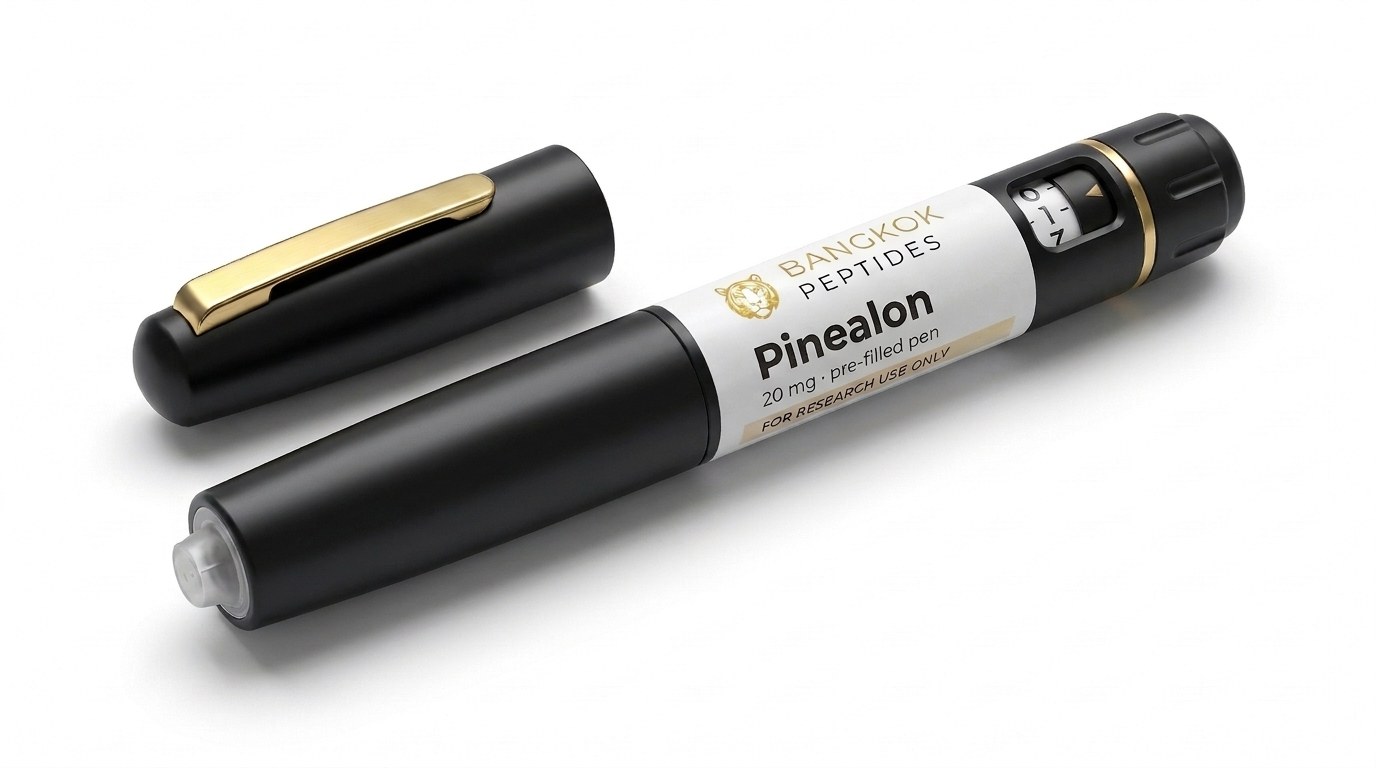
The catalogue lists Pinealon 20mg Pen as a pre-filled pen, and separately lists a Pinealon 20mg vial. These names identify two presentations with the same nominal catalogue amount. They do not establish matching formulation, measured delivery or equivalent effects.
The useful scientific description remains specific: a synthetic Glu-Asp-Arg peptide, the three named cell systems, induced oxidative stress and the two cellular measurements. Pinealon cell-stress study.